Stand Mixer Recipes Beyond Cake: What Each Attachment Earns Its Keep On
Affiliate disclosure: Kitchaneers is reader-supported. When you buy through links on this page, we may earn an affiliate commission at no extra cost to you.
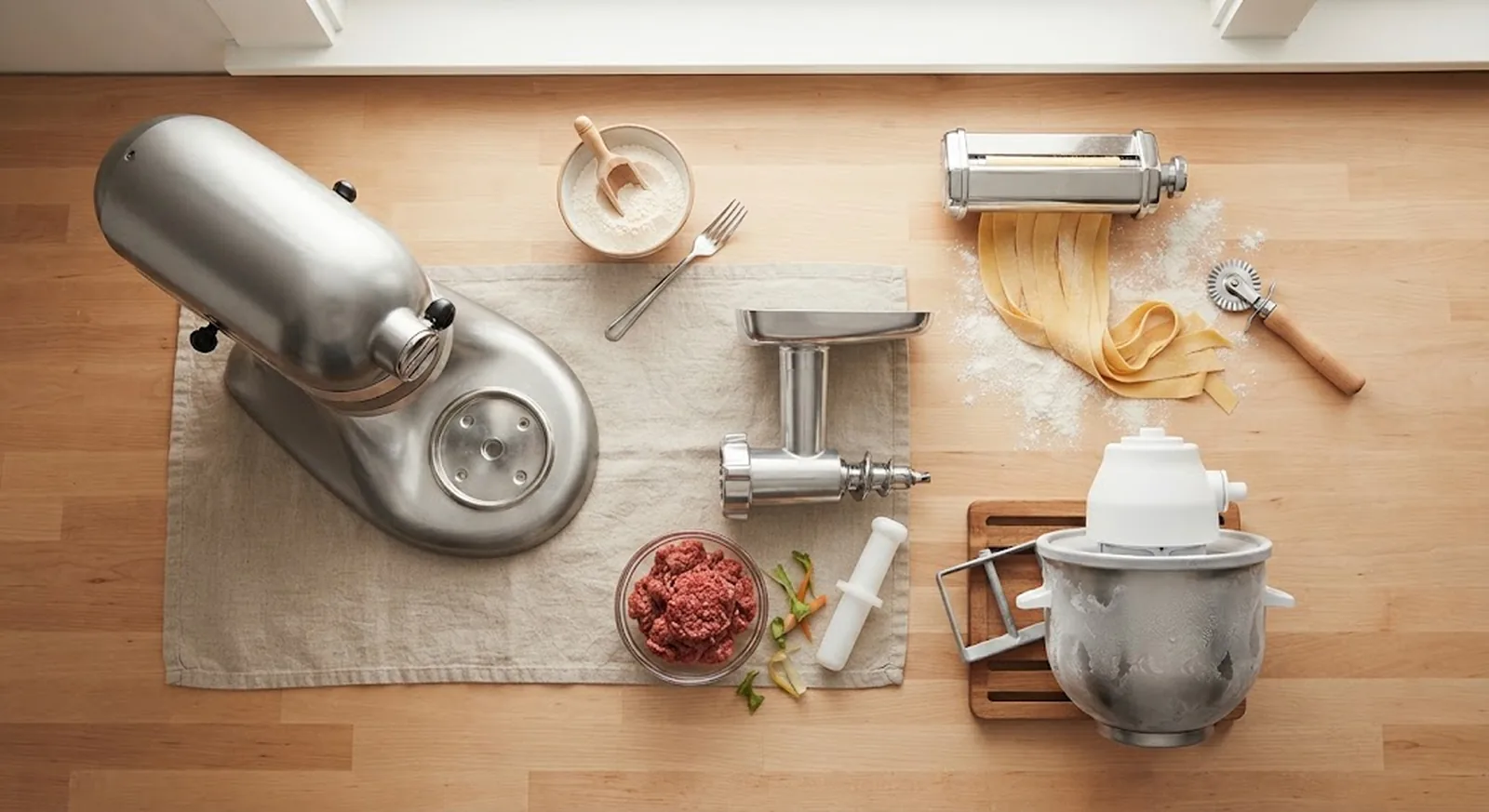
If you own a stand mixer, there’s a good chance the attachment hub on the front of it has never been used for anything but the three parts that came in the box: the paddle, the whisk, and the dough hook. Everything else people buy for it — the pasta roller, the grinder, the spiralizer, the ice cream bowl — tends to get used once, photographed for a group chat, and then stored in a cabinet. I’ve spent a lot of time going through verified-purchase reviews and long-term owner threads for KitchenAid’s attachment lineup, and a pattern shows up over and over: a handful of attachments earn their keep in regular rotation, and a couple are mostly bought on impulse and regretted by month three.
This isn’t another “best stand mixer attachments” shopping list — I already wrote that comparison in Best Stand Mixer Attachments You’ll Actually Use. This one is about what you actually cook with each attachment once it’s out of the box, and which ones are worth the drawer space based on how real owners say they used them a year in, not week one.
Why the Attachment Drawer Usually Goes Unused
The honest answer, pulled from recurring complaints in owner reviews, is that most stand mixer attachments get bought for a single occasion — a holiday, a diet trend, a “we’re going to make fresh pasta every Sunday” resolution — and then the occasion passes before the habit forms. The attachments that survive long-term aren’t the flashiest ones. They’re the ones that slot into something the household was already cooking weekly, just faster or with less cleanup than the stand-alone tool it replaced.
That’s the filter I used for this guide: for each attachment, what does it actually replace, how often does that task come up in a normal week, and is the attachment meaningfully better than doing it by hand or buying a dedicated gadget?
I pulled this pattern from reading through long-term, verified-purchase reviews for each attachment — specifically looking for reviewers who came back months or years after the original purchase to say whether it was still in use, rather than first-week unboxing impressions. The gap between “this is amazing” (week one) and “I still use this” (year one) is where the real signal is, and it’s wider for some attachments than others.
The Pasta Roller & Cutter Set: Fresh Pasta Without a Separate Machine
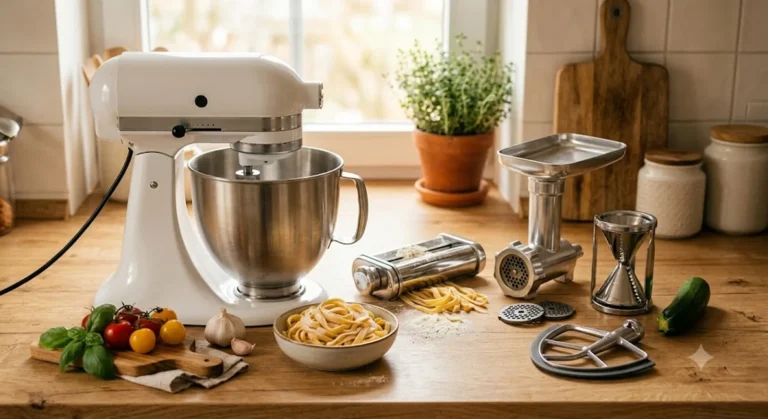
The three-piece roller and cutter set turns your stand mixer into a pasta machine — you feed dough through the roller attachment to thin it, then run it through the fettuccine or spaghetti cutter. If you already compared manual pasta machines to attachment-based ones in Manual vs. Attachment Pasta Makers, this is the attachment side of that decision made concrete.

KitchenAid KSMPRA 3-Piece Pasta Roller & Cutter Set
What it’s actually good for: fettuccine, spaghetti, lasagna sheets, and ravioli dough once you add a separate cutter. Owners who keep using it past the first month are almost always people who already made pasta by hand with a rolling pin — the attachment just removes the arm-work of rolling dough to an even thickness, which is the step most home cooks get wrong anyway. The honest con, repeated in review after review: it only mixes the motor-driven part of the process. You’re still kneading, resting, and portioning dough by hand, and cleanup for three metal attachments is more involved than wiping down a cutting board.
The recipes that make the most of it tend to be the ones where even thickness actually matters: lasagna sheets that cook uniformly instead of some edges turning mushy, or long noodles like fettuccine and angel hair where a hand-rolled sheet usually ends up thicker on one side. It’s less useful for anything stuffed, like ravioli or tortellini — you still need a separate cutter or a lot of hand-folding for that step, which is where a chunk of the “I thought this would do more” reviews come from. Owners who get the most mileage out of it usually make a double batch and freeze half, since the attachment doesn’t save much time on a single-portion batch once you count setup and cleanup.
The Food Grinder: Ground Meat, Burgers, and Sausage at Home
The grinder attachment turns the stand mixer into a meat grinder, which sounds niche until you notice how many recipes actually call for ground meat: burgers, meatballs, sausage, even coarsely ground vegetables for things like veggie burgers. Grinding your own means you control the fat ratio and the cut, which is the detail behind why a lot of “best burger I’ve made” claims in reviews trace back to blending two cuts of meat the grocery store doesn’t sell pre-ground.

KitchenAid KSMMGA Food Grinder Attachment
This is one of the attachments that recurring owner feedback says earns its keep — households that grill or make burgers regularly report using it every couple of weeks once it’s part of the routine, not just for a one-off project. The genuine downside: you need to partially freeze the meat first for a clean grind, which means a little planning ahead, and the parts need a full disassembly and hand-wash every time (none of it is a quick rinse job).
Beyond burgers, the recipes that come up most often in owner discussions are breakfast sausage patties (where controlling the fat-to-meat ratio changes the texture more than any seasoning does), homemade chorizo, and coarser grinds for chili meat that hold up better than store-bought ground beef through a long simmer. A few reviewers also use the coarse plate for vegetables — cauliflower “rice” or a quick slaw base — though a food processor does that job with less cleanup if that’s the main use case. The households who stop using the grinder are almost always the ones who bought it expecting to replace all their grocery-store ground meat purchases; the ones who keep using it are the ones who use it for the specific cuts and blends their butcher doesn’t sell pre-ground.
The Spiralizer: Vegetable Noodles and Low-Carb Swaps
The seven-blade spiralizer attachment turns zucchini, carrots, sweet potatoes, and similar vegetables into noodle-like ribbons or shreds, which is the main reason it gets bought in the first place: zucchini noodles as a lower-carb pasta swap, or quick slaw-style shreds for salads and stir-fries.

KitchenAid KSM2APC 7-Blade Spiralizer Attachment
This is a genuinely useful-but-niche pick. If low-carb or extra-vegetable meals are already a regular habit in your kitchen, owners report real long-term use. If zucchini noodles were a one-time Pinterest experiment, this is one of the attachments most likely to end up back in the box — the blade swapping between the seven cutting styles is fiddly enough that casual users default to a cheap handheld spiralizer instead once the novelty wears off.
Where it earns the most repeat use, beyond zucchini noodles, is thin ribbon-cut cucumber and carrot for quick pickles or slaw, curly-cut potatoes for an oven-fries alternative, and apple ribbons prepped fast for a pie filling instead of hand-slicing a bowl of apples. The seven interchangeable blades are the attachment’s biggest selling point and its biggest point of friction at the same time — more cutting styles than most people end up using regularly, and each swap means disassembling and rinsing a blade before the next one goes in. Owners who keep it long-term tend to settle on one or two blades they actually reach for and leave the rest in the box, which is worth knowing before buying the full set expecting to rotate through all seven.
The Ice Cream Maker Attachment: Worth It Only If You Already Own the Mixer
The ice cream attachment is a frozen bowl that locks onto the mixer and churns a custard or cream base into soft-serve-style ice cream in about 20–25 minutes. It’s a genuinely fun attachment for the handful of weeks a year when homemade ice cream sounds appealing, which is exactly the problem recurring reviews point to.

KitchenAid KICA Ice Cream Maker Attachment
The con that shows up most often: the bowl has to be fully frozen for 15+ hours before each use, which means you can’t decide on ice cream and have it an hour later — it only works if you plan ahead and keep the bowl in the freezer between uses, which takes up real freezer space. If you’d rather churn ice cream spontaneously, a dedicated countertop machine with a built-in compressor is the better fit; if you already have the mixer and the freezer space, this is the cheaper way in.
Owners who use it most get the best results from custard-based bases (egg yolks cooked with cream before chilling) rather than quick Philadelphia-style bases, since the extra fat and emulsification make a noticeably smoother final texture — reviewers consistently note that skipping the custard step is the most common reason for icy, grainy results. It’s also a solid attachment for mix-ins added in the last minute or two of churning: crushed cookies, chopped nuts, or swirled fruit sauce, since the paddle keeps everything moving evenly instead of needing to fold mix-ins in by hand afterward. The households that get the least use out of it are the ones who don’t have a reliable habit of pre-freezing the bowl, which turns “let’s make ice cream” into “let’s make ice cream tomorrow” often enough that the attachment quietly stops getting used.
The Flex Edge Beater: The Attachment That Earns Its Keep Every Single Bake
This one isn’t a specialty attachment — it’s a replacement paddle with a silicone edge that scrapes the bowl as it mixes. I’m including it here because, across every long-term owner thread I’ve read, it’s the single most-used attachment people buy after the mixer itself. It’s not really a “beyond cake” attachment; it makes everything the stock paddle already does — batters, doughs, frostings — faster, with less bowl-scraping by hand.

KitchenAid KFE5T Flex Edge Beater
Owner reviews consistently call this the best low-cost upgrade for a mixer that already gets regular use — the honest con is that it’s a mixing-quality improvement, not a new capability, so if you only bake twice a year it won’t change much for you. For anyone baking weekly, it’s the attachment with the shortest path from “purchased” to “actually used.”
The silicone edge matters most on thicker mixtures — cookie dough, cream cheese frosting, and cake batter made with cold butter — where the standard paddle tends to leave a ring of unmixed ingredients along the bowl’s sides that you’d otherwise have to stop and scrape down by hand, sometimes two or three times per recipe. For thinner batters like pancake or crepe mix, the difference is smaller, which is why reviewers who bake mostly quick breads and simple batters report less noticeable benefit than reviewers who make a lot of cookie dough or stiff frosting.
Attachment vs. Buying a Separate Gadget
Every one of these attachments has a stand-alone equivalent — a dedicated pasta machine, a countertop meat grinder, a handheld spiralizer, a compressor ice cream maker — and the honest comparison isn’t really about which does a better job. For most of these tasks, a dedicated single-purpose gadget performs about as well or slightly better, since it’s purpose-built instead of adapted from a mixer motor. The case for the attachment comes down to three things: you already own the mixer, so the marginal cost is lower than buying a whole new appliance; attachments store more compactly than a second countertop machine; and you’re not adding another gadget to clean, maintain, and find space for.
The case against the attachment route shows up when you’d use the stand-alone tool often enough that its dedicated features start to matter — a countertop ice cream maker with a built-in compressor that doesn’t need 15 hours of pre-freezing, or a manual pasta machine that’s faster to set up and clean for a quick weeknight batch. If a task is a once-a-year occasion, the attachment’s lower storage footprint usually wins. If it’s a weekly habit, it’s worth pricing out whether the dedicated version pays for itself in convenience over a year or two of regular use.
Which Attachments Are Actually Worth Buying?
Based on the pattern across owner reviews, here’s the honest ranking of how often each attachment gets used a year after purchase, from most to least:
- Flex edge beater — used every time the mixer runs, for anyone who bakes or mixes regularly. Lowest price tier of the group.
- Food grinder — used regularly if your household already grills or makes burgers/sausage often. Mid price tier.
- Pasta roller & cutter set — used regularly only if fresh pasta was already a habit, not a resolution. Mid-to-upper price tier.
- Ice cream maker attachment — used seasonally, worth it mainly if you already own the mixer and have freezer space to spare. Upper-mid price tier.
- Spiralizer — most likely to go unused unless extra-vegetable or low-carb meals are already a weekly habit. Lower-mid price tier.
None of these are “bad” attachments — reviewers who match the attachment to an existing habit are consistently happy with it. The regret almost always comes from buying an attachment for the idea of a new habit, rather than one that supports a habit already in place. If you’re still deciding whether the mixer itself is worth it before adding attachments, Is the KitchenAid Stand Mixer Worth It? and Best Stand Mixers Under $300 both cover that first decision, and Hand Mixer vs. Stand Mixer is worth a look if you haven’t committed to a stand mixer yet at all.
Frequently Asked Questions
Do stand mixer attachments fit every KitchenAid model?
Most attachments fit any KitchenAid stand mixer with the standard hub on the front, which covers the tilt-head and most bowl-lift models. It’s still worth checking the attachment listing’s compatibility notes against your specific mixer model before buying, since a small number of commercial-style models use a different hub.
Can these attachments work on other brands of stand mixers?
Generally no — hub-mount attachments like the pasta roller, grinder, and spiralizer are built for KitchenAid’s hub shape and won’t physically attach to a different brand’s mixer. If you own a different brand, check whether that manufacturer sells its own attachment line instead.
Which stand mixer attachment should I buy first?
Based on how owners actually use theirs long-term, the flex edge beater is the attachment most people get the most consistent use from, since it improves every single mix rather than adding a once-in-a-while capability. After that, buy based on what you already cook regularly — the grinder for households that cook a lot of ground meat, the pasta roller for households that already make pasta by hand.
Are stand mixer attachments worth the investment?
They’re worth it when they replace a task you’re already doing by hand or with a separate gadget on a regular basis. They tend to be a weaker investment when bought to start a new habit, since the data from long-term owner reviews shows the habit — not the attachment — is usually what doesn’t stick.
How many stand mixer attachments should I actually own?
Based on the usage patterns in long-term owner reviews, most households get solid value from two or three attachments tied to habits they already have, rather than collecting the full lineup. Buying one at a time, after you’ve confirmed the task comes up regularly without the attachment, avoids most of the “it’s still in the box” outcomes that show up in reviews.
Bottom Line
The attachments that are worth buying for your stand mixer are the ones that plug into something you already cook regularly, not the ones that look impressive in a product photo. If you bake often, start with the flex edge beater. If ground meat is already part of your weekly cooking, the grinder is the next best bet. Everything else — the pasta roller, the spiralizer, the ice cream bowl — is worth it specifically for the household that was already doing that task by hand and wants to do it faster, not for the household hoping the attachment will start the habit on its own.