The Real Difference Between an Immersion Blender and a Regular Blender
If you already own one of these and are wondering whether you need the other, the short answer is: probably, eventually, but not yet. An immersion blender and a regular (countertop) blender solve different problems, and buyer reviews make the split pretty clear once you look past the “blender” name they share. Heads up: this post contains affiliate links, which means I may earn a small commission if you buy through them — at no extra cost to you. I only recommend gear that holds up in verified buyer reviews and spec comparisons.
Here’s the difference between an immersion blender and a regular blender in one line: an immersion blender is a handheld wand you lower into a pot, built for small, fast, in-place jobs; a regular blender is a countertop machine with a jar, built for volume and brute force. Below is the honest breakdown of what each one actually wins at, plus which to buy first if you can only own one right now.
What each tool is actually built for
A regular blender — sometimes called a countertop or jar blender — is designed around a sealed container and a motor base strong enough to pull thick mixtures into a vortex. That design is what lets it crush ice, grind frozen fruit into a smoothie, and push through stiff nut butter without stalling. The trade-off is that everything has to go into the jar, and the jar has to come off the base to serve or clean.
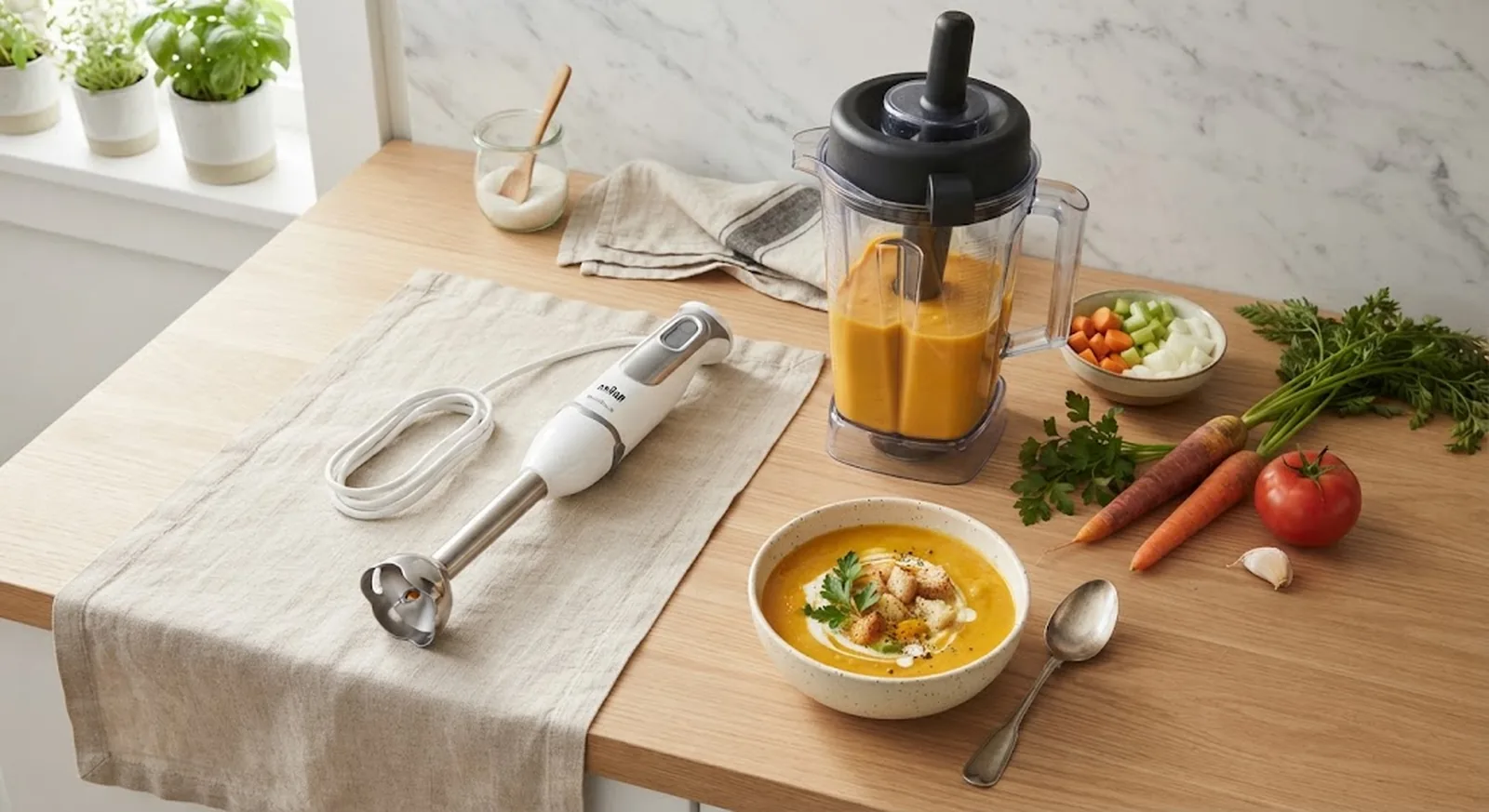
An immersion blender — also called a hand blender or stick blender — skips the jar entirely. The motor lives in the handle, and a blending shaft extends down into whatever container you’re already using: a soup pot, a mixing bowl, a measuring cup. It can’t generate the raw torque of a countertop machine, but it doesn’t need to — its whole job is working in a vessel you already have, with one part to rinse afterward instead of a jar, lid, and blade assembly.
Immersion blender vs. regular blender: side-by-side comparison
| Factor | Immersion blender | Regular (countertop) blender |
|---|---|---|
| Best for | Soup pureed in the pot, small-batch sauces, single smoothies, whipping cream | Ice, frozen fruit, nut butter, large-batch smoothies, milling |
| Typical power | 200–500W, torque-limited | 700–1,400W+, built for sustained load |
| Cleanup | Rinse one shaft under the tap | Wash a jar, lid, and blade assembly |
| Storage | Fits in a drawer | Claims counter space or a cabinet shelf |
| Batch size | Whatever’s already in your pot or bowl | Fixed by jar capacity (typically 48–72 oz) |
| Hot liquids | Blends directly in a hot pot (stainless shaft models) | Possible but requires venting steam and working in batches |
| Price range | Entry to mid-tier for most households | Entry to premium, wider spread |
How wattage and torque actually compare
Wattage gets printed in big numbers on both boxes, but it means something different for each tool. An immersion blender’s motor sits in your hand, so engineers cap its power to keep the whole unit light enough to hold steady for minutes at a time — most land in the 200–500 watt range, and a “turbo” burst button matters more day to day than the headline number. A countertop blender’s motor sits in a heavy base bolted to the counter, so it can run 700 watts or more without anyone having to hold it, and premium models push past 1,400 watts for grain milling and ice.
That gap shows up the moment you ask either tool to do the other’s job. Push an immersion blender through a thick, cold nut butter and the motor labors, the shaft heats up, and reviewers consistently report it stalling or shutting off to protect itself. Ask a countertop blender to puree soup directly in the pot — if you even could — and you’d be fighting the jar’s whole design, which assumes a sealed container and a vortex, not an open saucepan. Each tool’s power ceiling exists because of the job it was built for, not a manufacturing shortcut.
Jobs an immersion blender wins
Pureeing soup directly in the pot. This is the immersion blender’s signature move. Lower the shaft into a pot of simmering vegetables, keep it fully submerged before switching on to avoid splatter, and blend until smooth — no ladling hot liquid into a countertop jar in batches, no risk of a pressurized lid blowing off from trapped steam.
Small emulsions and sauces. A quick mayonnaise, vinaigrette, or pan gravy comes together in the container you already dirtied — a tall cup or the same saucepan — rather than requiring you to transfer a small quantity into a jar built for 48 ounces.
Single-serving smoothies. Blend straight into the cup or glass you’re drinking from instead of hauling out a full-size jar, running it, then washing a pitcher for one portion.
Whipping cream or eggs in small batches. Most mid-range and premium models ship with a whisk attachment that handles a cup or two of cream faster than dragging out a stand mixer and its bowl.
Cleanup and storage. One shaft rinses under the tap in seconds, or goes straight into the dishwasher on detachable models. The whole tool tucks into a drawer instead of claiming permanent counter real estate — a real consideration in a small kitchen.
Jobs a regular blender wins
Crushed ice and frozen drinks. An immersion blender’s motor and thin shaft aren’t built for repeated contact with hard ice — reviewers and manufacturers alike note it will dull the blade and strain the motor over time if you try. A countertop blender’s heavier blade assembly and sealed jar are designed around exactly this load.
Big-batch smoothies. A 48–72 ounce jar handles a household’s worth of smoothie in one pass; a hand blender is working one serving at a time, which adds up fast if you’re making breakfast for four.
Nut and seed butters. Whole almonds or peanuts pass through a stiff, sticky, paste-like stage before they turn into spreadable butter, and without sustained torque and ideally a tamper to push the mass back into the blades, most machines — including every immersion blender — just spin a hole in the middle instead of grinding through it.
Grain milling and dry grinding. Oat flour, fine breadcrumbs, and spice grinding need a dry container a hand blender’s open shaft design doesn’t have — this is strictly countertop-blender territory.
Consistency on thick purees. A jar blender with a narrow base and a tamper works through stiff mixtures — cashew cream, thick dips, dense batters — more reliably than a handheld shaft fighting the same resistance with a fraction of the torque.
Two picks worth owning (one of each)
Cuisinart CSB-179 Smart Stick — Best Immersion Blender for Most Kitchens
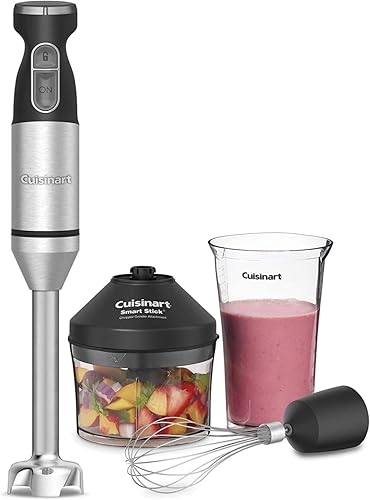
Variable speed, a stainless-steel shaft that tolerates hot soup, and a whisk plus chopper attachment included — this is the immersion blender I point most home cooks toward. It’s the three-in-one functionality of pricier models without the premium price tag, and the stainless shaft means you’re not gambling on plastic warping near a hot pot.
The honest con: the speed dial sits where your palm naturally rests, so it’s easy to nudge mid-blend. You adjust your grip around it after the first few uses, but it’s a real design quirk, not a dealbreaker.
Ninja Professional Plus — Best Regular Blender for Everyday Cooking
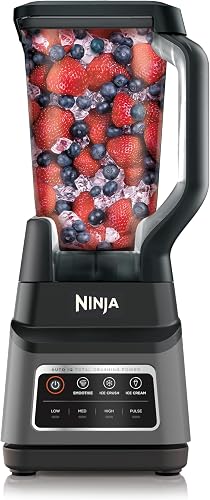
For the everyday list — pureeing soups in batches, blending sauces, crushing ice, big-batch smoothies — the Ninja Professional Plus covers it without the cost of a high-end machine. The stacked-blade tower pulls food down into the blades reliably, and the large pitcher is genuinely useful for batch cooking or a houseful of smoothie drinkers.
The honest con: the tall blade stack is awkward to clean by hand and a little nerve-wracking to reach around, and it can’t match a tamper-equipped premium blender on the thickest jobs like stiff nut butter — reviewers consistently report stopping to scrape the jar down.
For a deeper look at either category — including premium and budget options — see my full guides to the best immersion blenders for home cooks and the best blenders for home cooks.
Can one replace the other?
Mostly, no — and that’s the honest answer buyer reviews and spec comparisons keep confirming. The two tools overlap on soup and small sauces, but outside that narrow lane they diverge fast. An immersion blender genuinely cannot crush ice or grind nut butter without straining its motor; a countertop blender genuinely cannot match the convenience of blending soup directly in the pot you cooked it in, or rinsing one shaft instead of washing a jar for a single smoothie.
If your cooking is split between soup season and smoothie mornings, you’ll eventually want both — they’re inexpensive enough as a pair that most kitchens that use either tool regularly end up owning both within a year or two.
Which should you buy first?
Buy for the job you do most often, not the tool that sounds more impressive.
- Buy an immersion blender first if: you cook soup, sauces, or gravy regularly, you have limited storage and don’t want a jar claiming counter space, or you’re outfitting a small kitchen on a budget (it’s one of the first tools worth adding in my first-apartment kitchen essentials guide).
- Buy a regular blender first if: smoothies are a daily habit, you make frozen drinks or nut butter, or you cook for a household and need to blend in volume.
Price tiers for each tool
| Tier | Immersion blender | Regular blender |
|---|---|---|
| Entry | Single speed or basic variable speed, plastic shaft — fine for occasional soup | Compact jar, enough power for smoothies and light purees |
| Mid-range | Stainless shaft, true variable speed, whisk + chopper attachments | Full-size pitcher, enough sustained power for everyday cooking |
| Premium | Professional-grade motor (600W+), metal housing, trigger speed control | Tamper-equipped, variable-speed dial, sustained torque for nut butter and milling |
Whichever tier you land in, the appliance that earns its keep is the one matched to a job you actually do weekly — not the one with the biggest number on the box. For more on how I weigh that trade-off across the kitchen, see my guide to the best small kitchen appliances.
Noise, footprint, and attachments: the differences nobody puts on the box
A countertop blender at full power is genuinely loud — conversation-stopping loud, according to the reviews that mention it, especially the high-performance models with the torque to crush ice and grind grain. An immersion blender is noticeably quieter in normal use, in part because it’s working with less resistance and in part because the motor simply isn’t scaled to the same output. If you blend early in the morning in a house where other people are still asleep, that difference is worth factoring in before the price tag.
Footprint follows the same logic. A countertop blender needs a permanent spot — on the counter if you use it daily, or a cabinet shelf tall enough to clear the jar if you don’t. An immersion blender’s only footprint is a few inches of drawer space, which is a real advantage in the small-kitchen and first-apartment scenarios I cover in my kitchen essentials guide.
Attachments are where immersion blenders quietly earn back some of the ground they lose on raw power. Mid-range and premium models typically ship with a whisk attachment and a small chopper bowl, turning a one-trick tool into something that handles whipped cream, chopped onions, and herb purees as well — jobs that would otherwise send you to a stand mixer or a separate mini food processor. Countertop blenders rarely bundle anything beyond a tamper; their versatility comes from jar capacity and motor power, not add-on parts.
Three real kitchen scenarios
Weeknight soup for two. You’ve simmered carrots, onion, and stock in one pot. An immersion blender lets you puree it right there, rinse the shaft, and you’re plating in the time it would take to ladle the batch into a countertop jar, blend it in two rounds because it’s too full to do at once, and then wash the whole jar assembly.
Sunday smoothie prep for a family of four. This is the opposite case. A countertop blender’s large pitcher handles everyone’s smoothie in one batch with real ice-crushing power; running an immersion blender through four separate servings of frozen fruit would strain the motor and take four times as long.
Homemade almond butter on a Saturday. This job exposes exactly why the two tools aren’t interchangeable. Whole almonds need several minutes of sustained grinding through a stiff, paste-like stage before they loosen into spreadable butter — torque only a countertop machine with a tamper can deliver. An immersion blender will bog down and potentially overheat long before the almonds give up their oil.
How this comparison was put together
This isn’t a one-afternoon spec comparison. The conclusions above are drawn from cross-referencing hundreds of verified-purchase reviews on both tool categories — looking specifically at where owners report each tool struggling or excelling on real tasks (hot soup, frozen fruit, nut butter, single servings) — alongside manufacturer spec sheets for motor wattage, shaft material, and jar capacity, and price-tier comparisons across both categories. Where buyer feedback and specs agree consistently, that’s reflected as a clear win for one tool; where it’s closer, that’s reflected as genuine overlap rather than a forced verdict.
FAQ
Is an immersion blender as powerful as a regular blender?
No, and it isn’t trying to be. Most immersion blenders run 200–500 watts with limited sustained torque, while countertop blenders run 700–1,400 watts and are built around a jar designed to funnel thick loads back into the blades. The immersion blender wins on convenience for small, in-place jobs instead.
Can an immersion blender replace a regular blender for smoothies?
For a single serving blended in a tall cup, yes — reviewers use them this way regularly. For a daily smoothie habit with frozen fruit and ice, a countertop blender’s jar and motor handle the volume and hard ingredients more reliably without straining.
Do I need both an immersion blender and a regular blender?
If your kitchen regularly needs both soup-pureeing and smoothie-making, eventually yes — they’re complementary rather than redundant, and both are inexpensive enough that most active home cooks end up owning both.
What’s the main difference between a hand blender and a stick blender?
Nothing — “hand blender,” “stick blender,” and “immersion blender” are three names for the same handheld tool. The naming varies by brand and region, not by function.
Which is easier to clean, an immersion blender or a regular blender?
The immersion blender, by a wide margin. Detach the shaft and rinse it under the tap or run it through the dishwasher if the manufacturer allows — there’s no jar, lid, or blade assembly to disassemble the way a countertop blender requires.
Do professional kitchens use immersion blenders?
Yes, constantly — restaurant kitchens use them for exactly the reason home cooks should: pureeing large pots of soup or sauce without transferring hot liquid into a separate jar in batches. Professional-grade immersion blenders scale up the same idea with more powerful motors, but the core advantage — blending in place — is identical to a home model.
Which lasts longer, an immersion blender or a regular blender?
Well-built versions of both last for years, but a countertop blender used within its design limits — not pushed to grind nut butter daily on a budget motor — tends to outlast a cheap immersion blender used past its torque ceiling. The single biggest lifespan factor for either tool is simple: match the machine to the job, and don’t ask a small motor to do a big motor’s work.
The bottom line
An immersion blender and a regular blender aren’t competing for the same job — one is built for working in the container you already have, the other for volume and brute force a handheld motor can’t match. If you only cook soup a few times a month and want to save drawer space, start with an immersion blender like the Cuisinart CSB-179. If smoothies, frozen drinks, or nut butter are a weekly habit, start with a countertop machine like the Ninja Professional Plus. Most kitchens that use either regularly end up with both — and once you do, you’ll reach for each one for exactly the jobs it’s built for, not the one it isn’t.