5 Kitchen Habits That Wreck Your Cookware (And What to Do Instead)
This post contains Amazon affiliate links. If you buy through them, Kitchaneers may earn a commission at no extra cost to you.
Most cookware doesn’t fail because it was cheap. It fails because of five small habits repeated a few hundred times a year — the kind of thing nobody notices in the moment because the pan still “works fine” the next day. The damage is cumulative: a scratch here, a warp there, a stripped-down coating that quietly stops releasing food the way it used to. None of these five habits require new equipment to fix. They just require catching yourself mid-motion, which is harder than it sounds once a habit is a habit.
Quick reference: the 5 habits and their fixes
| Habit | What it damages | Quick fix |
|---|---|---|
| Metal utensils on nonstick | Scratches the coating until it stops releasing food | Switch to silicone, wood, or nylon tools |
| Cold water on a hot pan | Warps stainless and cast iron; stresses nonstick coatings | Let the pan cool a few minutes before it touches water |
| Soap, soaking, or dishwasher on cast iron | Strips seasoning and invites rust | Hand-wash lightly, dry fully, re-season as needed |
| Stacking pans bare | Scratches interior coatings during storage | Add a towel, felt protector, or paper towel between pans |
| High heat on an empty pan | Causes uneven expansion and warping; degrades nonstick faster | Preheat on medium, add oil or food before cranking the heat |
1. Using metal utensils on nonstick (and nonstick-coated) pans
A metal spatula scraping across a PTFE or ceramic coating doesn’t destroy the pan in one pass — it leaves a microscopic scratch, and then another, and then a visible one, until the coating is thin enough that food starts sticking in patches. Reviewers on budget and premium nonstick pans alike flag the same pattern: the pan performs perfectly for months, then develops sticky spots exactly where a metal tool was dragged repeatedly. The fix costs almost nothing — switch to silicone, wood, or nylon utensils at the stove, and keep metal for stainless steel and cast iron, which can take the abuse. If you’re shopping for a replacement pan anyway, our roundup of nonstick pans that actually hold up breaks down which coatings resist this kind of wear longest, and how long non-stick coating really lasts walks through the other five signs a coating is on its way out.
2. Rinsing a hot pan under cold water
This one feels efficient — get the pan in the sink, hit it with cold water, move on to the next dish. It’s also the fastest way to warp a pan. Metal expands when it’s hot and contracts when it cools, and a sudden blast of cold water forces that contraction to happen in seconds instead of minutes. Stainless steel is especially prone to warping this way (the base stops sitting flat on the burner), and cast iron can crack or buckle under the same stress. Thin nonstick pans take it too, just more quietly, with the coating degrading a little faster each time. The fix is just patience: let the pan sit off the heat for a few minutes before it touches water, or add a splash of lukewarm (not cold) water first if you’re in a hurry to start soaking.
3. Soap, soaking, or the dishwasher on cast iron
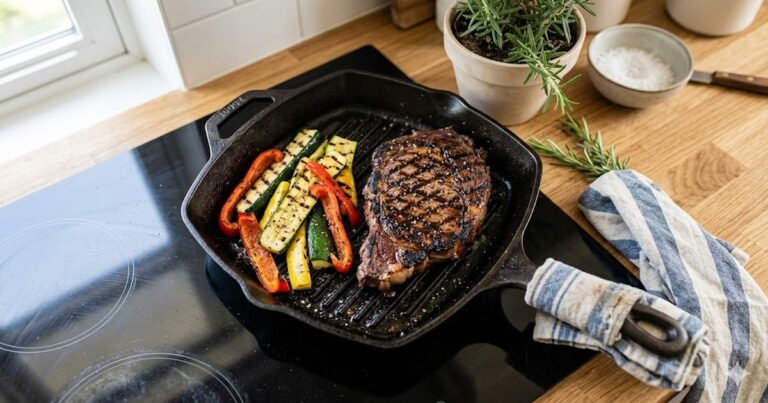
A well-seasoned cast iron pan can handle a quick, light pass of soap now and then without disaster — but soaking it, running it through the dishwasher, or scrubbing it with steel wool strips the seasoning layer that took weeks to build. Once that layer is gone, food sticks again and the bare iron underneath is exposed to rust, especially if the pan sits wet for even an hour. The habit that causes the most damage is usually leaving a cast iron pan in a sink full of water to “deal with later” — by the time it finally gets washed, it’s picked up a dull, splotchy look that means re-seasoning from scratch. If a pan’s already there, our guide to cleaning cast iron without ruining the seasoning covers the right daily routine, and our step-by-step guide to seasoning a cast iron skillet covers the recovery process and the three most common mistakes that cause it in the first place.
4. Stacking pans with nothing in between them
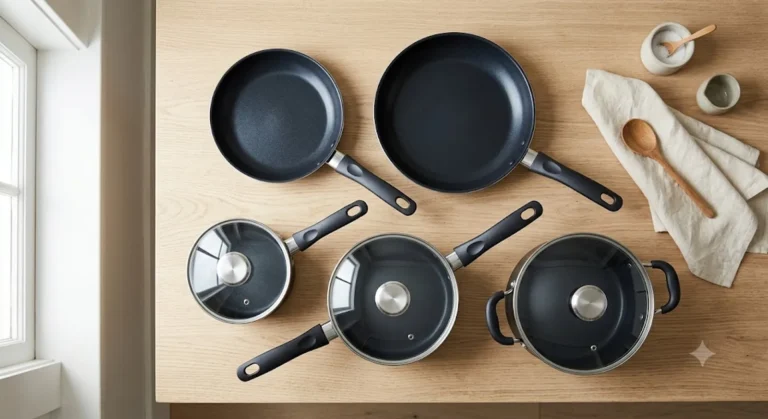
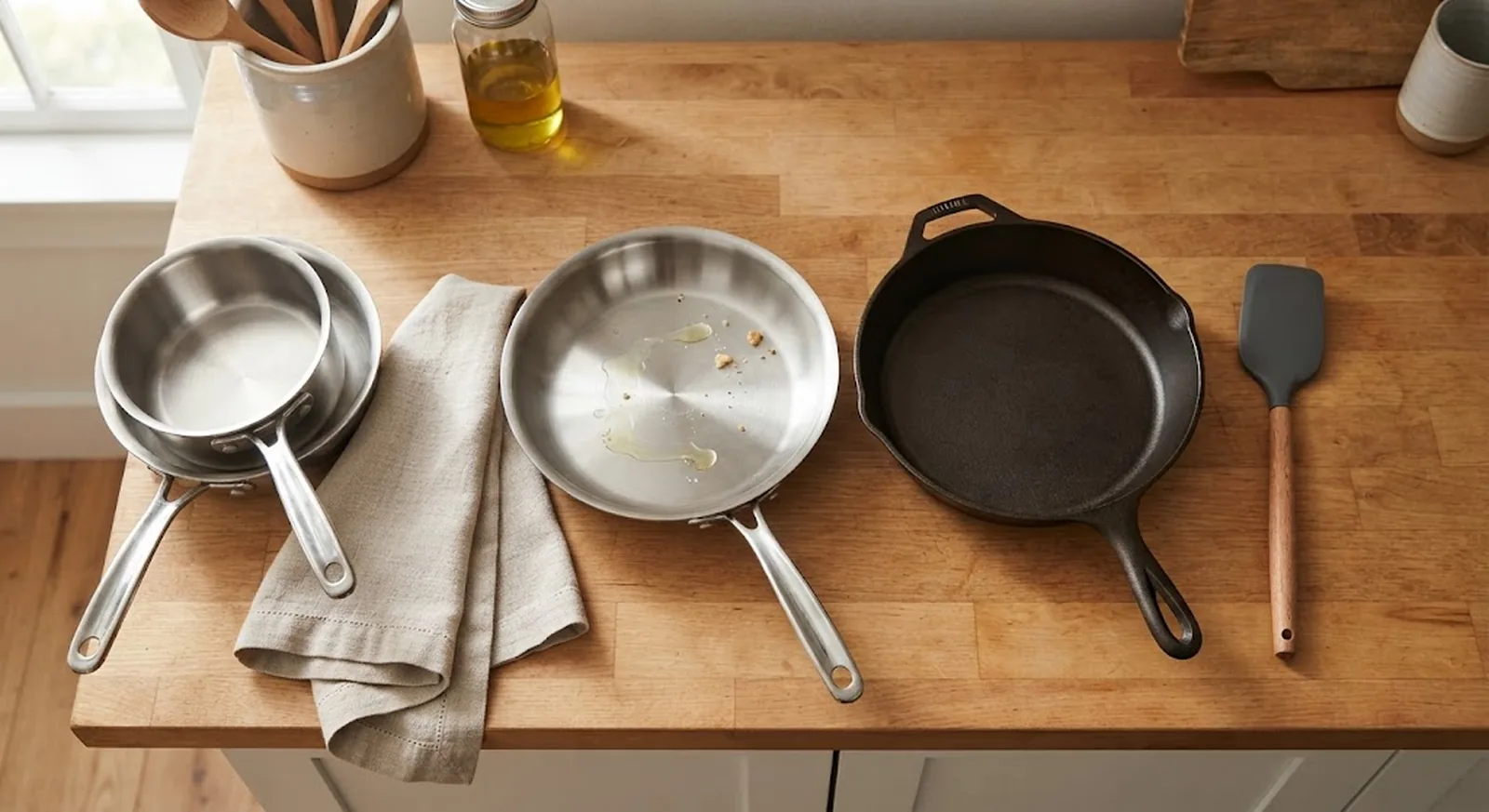
Nesting pans to save cabinet space is reasonable; nesting them with bare metal or coated surfaces grinding against each other every time a drawer opens is how a nonstick interior ends up looking sandblasted within a year. The scratches are usually on the inside of the bottom pan, left by the rim of whatever’s stacked on top of it, and they’re easy to miss until the coating starts flaking during cooking. A folded kitchen towel, a cheap felt pan protector, or just storing pans with a layer of paper towel between them solves this permanently and costs less than a single replacement pan.
5. Cranking the heat on an empty pan
Preheating an empty pan on high — especially a thin nonstick one — heats the center faster than the edges, and that uneven expansion is a slow route to warping even without the cold-water shock from habit #2. On nonstick specifically, dry high heat also accelerates coating breakdown and can release fumes well before the pan is hot enough to cook on. Stainless and cast iron tolerate higher heat than nonstick, but even they do better with a gradual ramp: medium heat until the pan is evenly hot, then adjust up if the recipe calls for it, with oil or food added before the pan sits empty on high for more than a minute or two.
The pattern behind all five
Every habit on this list comes down to the same thing: treating cookware like it can absorb sudden extremes — of temperature, of abrasion, of being left wet — without consequence. None of it shows up as damage the first time. It shows up six months later as a pan that used to work perfectly and now doesn’t, which is exactly why these habits are so easy to keep without noticing. The good news is that none of the fixes require buying anything expensive or changing how you actually cook — they’re all about the thirty seconds before and after the meal, not the thirty minutes in between. Swap the utensils, give the pan a minute to cool, keep cast iron dry, add a layer between stacked pans, and ease into high heat instead of starting there. For the full day-to-day routine across cast iron, nonstick, knives, and more, our complete kitchen tool care guide is the reference page worth bookmarking.
FAQ: Habits that damage cookware
Can a scratched nonstick pan still be used safely?
Light surface scratches are mostly a performance issue, not a safety one. Once the coating is flaking or peeling into food, it’s time to replace the pan rather than keep cooking with it.
Is it ever okay to put soap on cast iron?
A small amount of mild soap on a well-seasoned pan is generally fine for a quick wash. What actually damages the seasoning is prolonged soaking, steel wool, or the dishwasher — not a few drops of soap and a sponge.
How long should I let a hot pan cool before washing it?
A few minutes off the heat is usually enough to avoid the worst of the thermal shock. If you’re not in a rush, letting it cool closer to room temperature before it touches water is the safest habit.
Does this apply to ceramic-coated cookware too?
Yes. Ceramic coatings are more heat-tolerant than PTFE in some ways, but they’re just as vulnerable to metal utensils, abrasive scrubbers, and the dishwasher’s heat and detergent cycle.
What’s the single most damaging habit on this list?
Thermal shock from cold water on a hot pan tends to cause the most irreversible damage — warping can’t be undone the way a stripped nonstick coating or a rusty cast iron pan sometimes can.